May 28, 2010
Time & the1 1/2 month mark!
May 26, 2010
Sassy Satire
Hilarious. I am very disappointed I just discovered this internet gem.
May 24, 2010
Understanding the Wookie
Or How I lost my Star Wars Virginity
I have been writing this blog fragmented since I watched Star Wars, all three original, on grainy VHS rented from the library last week. I can’t really critique the movie adequately-rather it made me think of the power of the imagination; and how, when one acts out on the imagination, it can do incredibly powerful things. To think that the movie was once a creative idea inside a mind.
I never refused to watch Star Wars—I just simply did not see the point. I understood it was a classic, I understood the popular references, what I didn’t understand was why people seemed so flabbergast about me not watching it.
I simply didn't have the time to sit through hours of a movie I didn't understand or seem to care about. I had things to do.
This all changed when I checked the rectangular, beat-up and worn movies from the library. I sat down, popped them in, just for the hell of it, not knowing that I would actually enjoy the hours I would spend watching the characters develop and the plot unfold.
The movie is incredible contextualized with the time period it was made. It was groundbreaking, the plot and interwoven character development are very complex, the visual effects , while almost laughable now, were advanced, and most importantly, the entire scenario of space is very imaginative.
It is this that I would like to elaborate on.
By using space as the setting, it leaves reality behind and allows for a form of escape. It allows viewers to travel to familiar settings from a different perspective, it shows the power struggle between good and evil in its complexities and it emphasizes the struggle of identity, place and meaning. These are all very human, very important and can reach beyond the screen to viewership and everyday life. This is difficult to do, while simultaneously creating a well done movie and marketing it as a blockbuster.
I could do a critique, but that seems too verbose, there are so many of them on the internet to compete with. Just know, if you have not seen Star Wars, watch it. It is a classic for a reason. Once you have watched it once, I highly suggest doing the Star Wars Drinking Game along with it. This makes for an entirely unique and blurry realization and perspective of a classic, best done with good friends, preferably the nerdy chic ones.
I will then leave you with my friend Kelsey and I with Yoda.
May 19, 2010
May 18, 2010
Post-Grad smooozing
The Brief Wondrous Life of Oscar Wao- Junot Díaz
May 8, 2010
Restored faith
On one hand, someone needs to show these blokes some sun. On the other, the crisp subtle deterioration of relationships through the choreography is very well done. The XX is incredible.
I will always have a nostalgic place in my heart for Built to Spill. Driving through the open space of Eastern Washington always makes me fall in love with the state I am from all over again. Falling in love with Space.
http://gogorunifyoucan.blogspot.com/2009/02/dear-washington.html
May 3, 2010
Baby, I've got the Blues
I believe that strong music, good music is based off of the artist conveying something that transcends the sounds they produce -- the sine cosine waves that are inevitable reverberation, that are a product of instruments. I mean, making noise is easy, but making good noise, noise with tone, emotion and meaning is incredibly difficult to do. After all, the rest it is just noise, just sound to fill the silence.
I am currently reading, "The Rest is Noise: Listening to the Twentieth Century." it is written by the music critic from The New Yorker, Alex Ross. It begins with the fin de siecle of the 19th century and the decadent movement with the Opera, "Salome"- an interpretation of Oscar Wilde's play by Strauss. It was a huge success. It made Strauss famous-- and more importantly, it made him money. Lots of money. It was also an incredibly complex, beautiful, meaningful, good piece of music.
This was also the time that artistic production began to become a commodity in a Modern, Capitalistic system. Music was now something that was to be consumed. Music was something thrown into the market to make money. This eventually led to a huge socialist push at the beginning of the 20th century/end of the 19th century by many artists. They did not want economics put onto self expression- to art.
The book then goes on to explain all of music in terms of cultural relevancy, of its artistic tonality and various components. Ross makes the reader see music is more than just sound.
As I am reading the time period of Harlem, of Chicago, of Atlanta-- of the blues, the many different types of blues, I see the oppression-- I see the struggle, I see the simplicity, I see the emotion. And, I remember this quote by Jimi Hendrix, "Blues is easy to play, but hard to feel"
The first picture above picture is of Chess Records and its artists. I will not name them because, well, let's face it, if I got one wrong, it would be incredibly embarrassing. But, just look at the faces, the race, the power dynamics, the man behind the desk. Back in July I wrote the following post about the record, "Blues James at Chess"
http://gogorunifyoucan.blogspot.com/2009/07/fuck-yes-moment.html
I know I cannot understand complete cultural oppression, I know I am a white middle class female who has been handed things to me that I have not earned, but goddamnit! I love the blues. I love it because it represents struggle, emotion and freedom-- everything that is wonderful about music, everything that I love about music. For some reason, I feel like this record is going to be symbolic of this time period in my life. It isn't poppy, it isn't pretty, it isn't sugar coated, it raw, its uninhibited, it is honest, it is vunerable, and it carries an air of sincerity and uncertainty. It was recorded in a time of great cultural shift. I know it is incredibly ego-centric to relate music directly to my life, music of great struggle-- a struggle I can never truly understand, but something resonates deeply with me. The music transcends the vinyl, the rotating black sphere on my record player and really makes me feel something. That, my friends, is art.
And that brings me back to the beginning of the post, to the thematic ideas in Alex Ross's book. Music is sound, it is really JUST noise, but it is also, paradoxically, so much more than that. It also ties into the beauty of the moment, to one of the central themes of Strauss's Opera, "Salome" of Oscar Wilde's play, of the decadent movement in which Ross purposively opens his novel with.
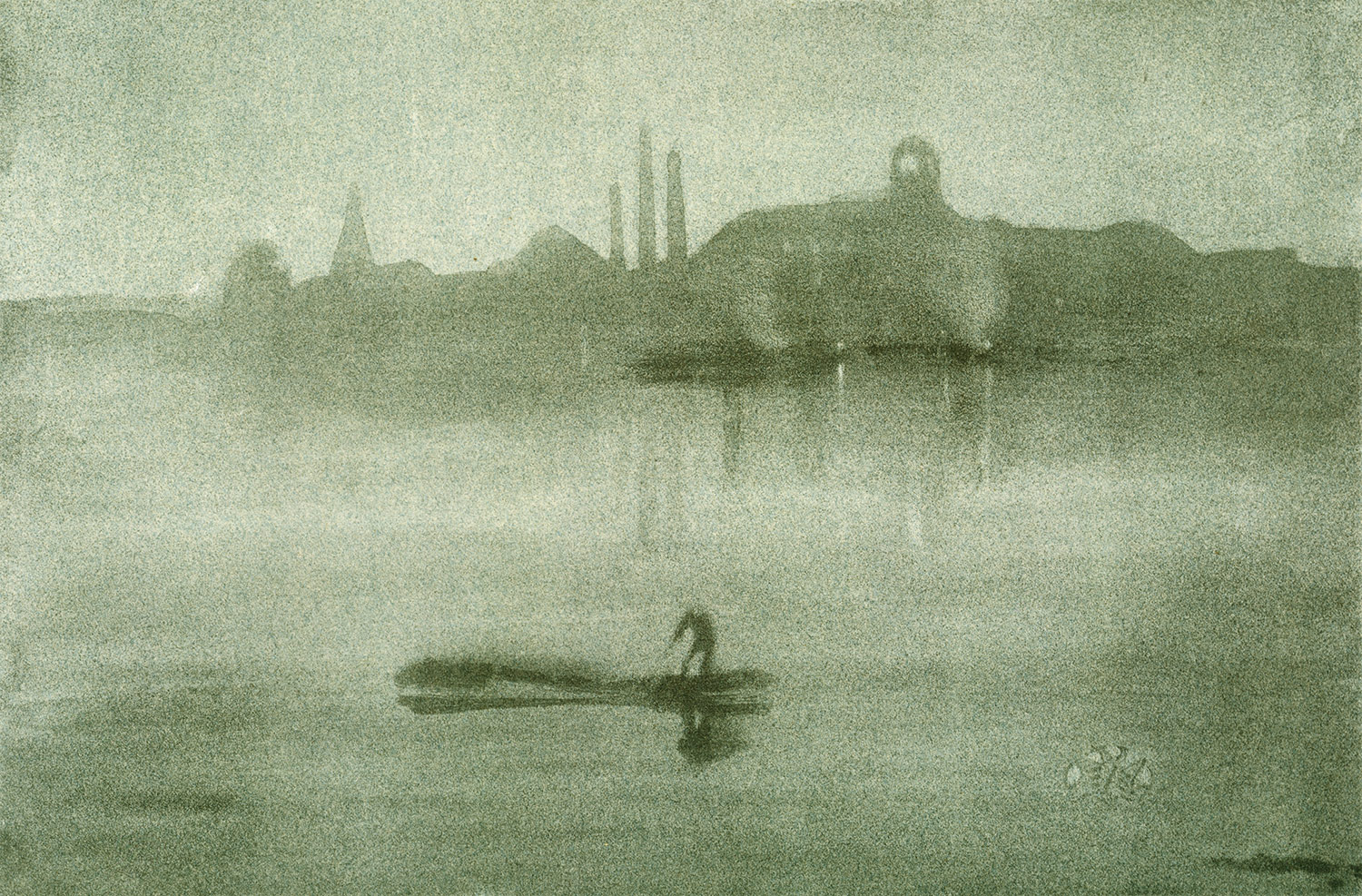
And, I tie this into James Whistler (Decadent painter, friend of Oscar Wilde) and his painting I saw in the MET while in NYC.
The painting itself simply represents a human on a boat, fog, a city in the background. It contains nothing more. It is simple. It is a moment. That is beautiful. It made him money, in a Capitalistic system where art was to be consumed. It made him famous, much like Strauss adaptation of Salome, much like the record, "Blues Jam at Chess" will represent the moment of post-graduation confusion, chaos and freedom for me. A mere moment. But, at the same time, it is so much more than just noise.